Facts · context · documentation

Mehdi Mousavi

A factual briefing concerning the sustained harassment and smear campaign targeting Iranian poet Mehdi Mousavi, translator and poet Fatemeh Ekhtesari, and people and organisations associated with their work.

Campaign The Last Kiss Book Smear Campaign
1+ year Sustained campaign
Type Harassment and smear campaign
Documented With Norwegian police and PST
Summary

Why this page exists

For more than a year, serious allegations concerning Mehdi Mousavi have been circulated online and sent directly to organisations, venues, journalists, publishers and people working with him. Fatemeh Ekhtesari, the translator of The Last Kiss and herself an Iranian poet in exile, has also been targeted.

Organisations have repeatedly been placed in the position of having to assess these claims. Despite this sustained activity, no event known to us has been cancelled, no invitation withdrawn and no professional collaboration ended on the basis of the allegations. No criminal charge has been brought against Mehdi in relation to them.

This page does not ask anyone to accept an account on trust. Its purpose is to separate established facts from unsubstantiated allegations, provide independent sources, and make relevant documentation available to organisations and journalists who need to assess the matter for themselves.

Background

Who is Mehdi Mousavi?

Mehdi Mousavi is an Iranian poet and writer, born in 1976, and a leading figure in the postmodern ghazal movement.

His poetry, teaching and literary workshops have influenced a generation of Iranian writers. His work has addressed ordinary life, political repression, censorship and resistance in Iran.

He was arrested and imprisoned in Iran because of his literary work, later fled the country, and came to Norway through the ICORN Cities of Refuge programme.

Documented history

Arrest, imprisonment and sentence in Iran

Mehdi Mousavi's prosecution in Iran is extensively documented by international media and freedom-of-expression organisations.

He and Fatemeh Ekhtesari were arrested in 2013 and held in Evin Prison, including periods of solitary confinement and interrogation.

Mehdi was subsequently sentenced to nine years in prison and 99 lashes. Contemporary reporting and free-expression organisations documented charges connected to his poetry, publishing and expression, including accusations of insulting religious sanctities and propaganda against the state.

The documented reasons for his prosecution in Iran are therefore not a matter of later interpretation or reconstruction.

2013

Arrested

Mehdi and Fatemeh were arrested and detained in Evin Prison.

9 years

Prison sentence

Mehdi was sentenced to nine years in prison.

99 lashes

Corporal punishment

Mehdi was also sentenced to 99 lashes.

Exile

Flight from Iran

He later fled Iran and eventually relocated to Norway through ICORN.

Current situation

Pattern of the harassment campaign

For more than a year, Mehdi Mousavi and Fatemeh Ekhtesari have been subjected to a sustained pattern of online attacks and direct approaches to people and organisations associated with their work.

Activity has repeatedly intensified around public events, publications and other professional appearances.

In addition to social-media posts, allegations have been sent directly to event organisers, venues, journalists, publishers and professional partners, frequently accompanied by requests or pressure to cancel events, withdraw invitations or distance themselves from Mehdi and Fatemeh.

The allegations have not remained consistent. Preserved material shows changes in emphasis and presentation over time. In a number of instances, claims appear to have been adapted to the particular interests or responsibilities of the organisation being approached. The seriousness of the accusations has also escalated.

Some of the people circulating these claims can appear credible at first sight. In several cases, however, basic checks of publicly available information have identified significant inconsistencies in stated identities, affiliations, relationships, timelines or accounts of events.

01

Activity around public work

Activity has repeatedly intensified around events, publications and other professional appearances.

02

Pressure on third parties

Allegations have been sent directly to venues, organisers, journalists, publishers and professional partners.

03

Changing allegations

The emphasis and presentation of the allegations have changed and escalated over time.

04

Verifiable inconsistencies

Basic checks have identified inconsistencies in some stated identities, affiliations, relationships, timelines or accounts.

Current status

What is established

After more than a year of repeated circulation and direct approaches to organisations, there is a substantial factual record against which the allegations and the campaign surrounding them can be assessed.

No criminal charge

No criminal charge has been brought against Mehdi in relation to the allegations.

No court finding

No court has made a finding against Mehdi in relation to the allegations being circulated.

No known event cancellation

No event known to us has been cancelled, invitation withdrawn or collaboration ended on the basis of the allegations.

The allegations are denied

Mehdi denies the allegations and no substantiated evidence establishing them has been presented to us.

The harassment has been reported

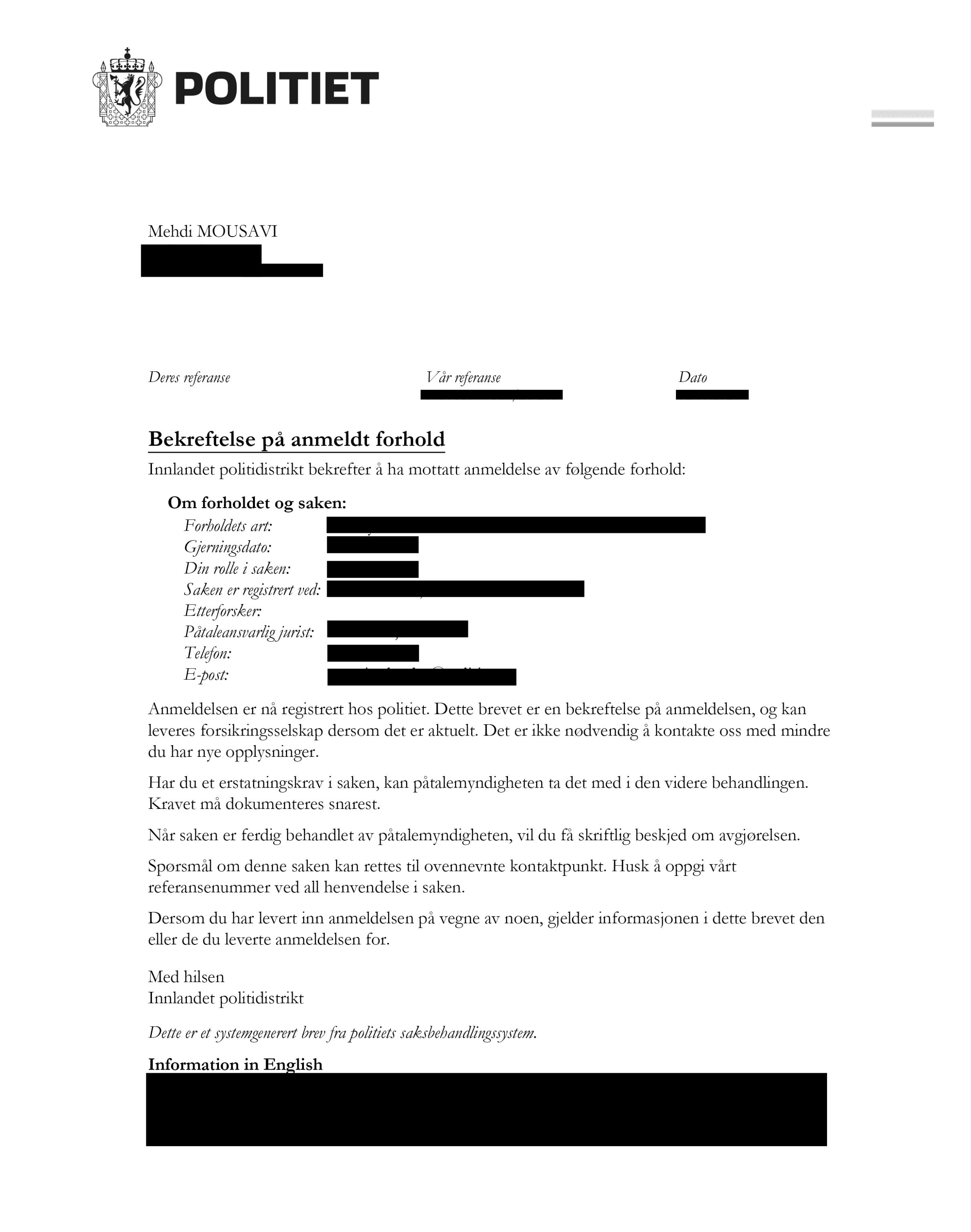
Mehdi has approached Norwegian police and security authorities concerning the ongoing harassment campaign.

Documentation

Police and security authorities

The harassment campaign has been reported to the relevant Norwegian authorities and evidence has been preserved.

Dates, correspondence, screenshots and other relevant material can be made available to appropriate organisations and journalists where necessary.

Personal information, private correspondence and material that could interfere with police or security work will not be published publicly.

Context

A documented pattern of transnational repression

Harassment, reputational attacks and attempts to isolate Iranian dissidents abroad do not occur in a vacuum.

Norway's Police Security Service has documented Iranian intelligence activity directed towards dissidents in Norway. Its threat assessments identify dissidents, human-rights organisations, academics and journalists critical of the Iranian authorities among relevant target groups.

Independent research has also documented harassment, intimidation, surveillance, online attacks, information manipulation and smear campaigns among methods used in transnational repression.

This wider pattern is relevant context. It is not, by itself, evidence identifying who directs this particular campaign.

Official statement
Statement by

Mehdi Mousavi

Statement concerning the allegations

Over the past months, I have been subjected to a coordinated, sustained, and organised campaign of harassment and defamation that has caused serious physical, psychological, and financial harm.

During this period, I have sought to avoid public disputes and unnecessary controversy. Instead, with the assistance of professionals, I have focused on carefully documenting this campaign, preserving and collecting evidence, and pursuing the matter through the appropriate legal channels.

My objective in pursuing this case is not merely to hold accountable those who knowingly participated in spreading false allegations, but also to establish the truth: how this campaign developed, who or what has driven it, and what motivations, pressures, or wider interests may lie behind it.

Although this process is time-consuming, costly, and difficult, I intend to continue pursuing cases involving individuals who have played a significant role in this campaign until the matter has been fully addressed through the judicial process.

Any developments in this case will be communicated through my official accounts. Until then, I intend to focus on my artistic and social work and to refrain from publishing further statements or comments about the individuals involved, so that the legal process may proceed in its natural course.

I would like to express my sincere gratitude to everyone who has shown their support through private messages and personal communications during this period. I am also grateful to those who have contributed to documenting this case and clarifying its circumstances by sharing relevant information, evidence, and supporting materials. If anyone possesses information or documentation that may assist the ongoing investigation, they are welcome to send it to: []

I would also like to express my sincere appreciation to the Norwegian security authorities for their swift and professional handling of this matter.

Professional record

Public work has continued

During the period in which the allegations have circulated, Mehdi and Fatemeh have continued to publish, speak, perform and work with established literary, educational and human-rights organisations.

Organisations receiving hostile communications have repeatedly proceeded with events and professional collaborations.

That should not be treated as a formal adjudication of the allegations. It does, however, show that repeated attempts to secure cancellations, withdrawn invitations or professional isolation have not produced those outcomes.

Practical guidance

If you are contacted

Good practice is to acknowledge the communication briefly and neutrally without entering into argument or discussion.

Thank you for making us aware. We have noted your message.

Keep relevant emails, messages and voicemails. For telephone calls, make a short note of the date, time, caller and substance of the contact where possible.

Avoid circulating serious allegations more widely than necessary while they are being assessed.

Relevant material can be sent to the reporting address below.